Showing posts with label Raymond A. Palmer. Show all posts

Saturday, April 12, 2014

SCIENCE FICTION HISTORY 1955-56: SOME FANS DECRY RAY PALMER'S "TARZAN ON MARS" PROJECT


RAY PALMER
Writer/fan Joe Gibson spoke for many, likely most, fans in 1955 when he accused former Amazing Stories editor Raymond A. Palmer of operating a "medicine show." Palmer, who had published several Edgar Rice Burroughs's novels in Amazing, had known the late author's son Hulbert for years. Starting with a large headline on the cover of his current magazine, Other Worlds, that proclaimed "Tarzan Never Dies!" Palmer, who had successfully authored several tarzanesque novels in his Toka, King of the Dinosaurs, series,  claimed there could never be enough Tarzan stories to satisfy the author's current fans or new ones that would develop over the years and that it would be a crime for the character to die with the passing of his author. Palmer asked fandom, or at leas his readers, to join him in a crusade to persuade Hulbert and the Burroughs estate to license Palmer to appoint a new writer to carry on the famous apeman's adventures. The book was sure to garner world wide publicity and windfall sales. Palmer urged fans who agreed to send him enthusiastic letters to show the Burroughs interests, stating they supported his endeavor and would buy such a book if it were published. Plus a ten cent contribution to help defray his mailing expenses. The buying power of a dime in 1955 was about that of a dollar today, and a stamp was 2 cents. So the cash strapped Palmer, whose magazine was not flourishing, could potentially net several hundred dollars in today's terms. And there was definitely a P. T. Barnum side of Palmer that had helped build Amazing Stories to number one in sales among science fiction magazines during his tenure. Just consider the Shaver Mystery. Or hi later playing up of the flying saucer fad. And not every story he had ballyhooed had necessarily lived up to its billing. So some, perhaps many, fans felt they justifiably viewed his antics with a jaundiced eye. His efforts to have new Tarzan novels written, therefore were met with skepticism by them.
  
 A letter by Joe Gibson headlined "Ray Palmer's Medicine Show" kicked off the letter column in the November 1955 issue of Other Worlds: 
    "There's a legend kicking around," Gibson had written, "out somewhere in my country, which is the wild and woolly West, about the character who rambled around in an old wagon with "Meddicin Show" burnt on the tailboard by a hot running iron. He had a little she-jackass that could dance to a [harmonica] (when she was a mind to) and he peddled a cure-all remedy that was guaranteed to take the warts off a toad or foal a dry mare, among other things. The thing was, this feller actually believed his remedy did some good because it sold well—and it did, too, but not for that reason. Thing was, this feller was from back East someplace and was kind of ignorant. So some feed merchant sold him some stuff to mix in his remedy because it "pepped up" animals. So this feller's remedy had a pinch or two of Spanish Fly mixed in with the thin molasses, red pepper and beet juice. It "pepped up" humans pretty well, too. And everybody knew it but this medicine-show feller. Was a regular side-splitter every time he got up to start selling the stuff. The womenfolk finally got wind of what was gain' on, tho, and some of the boys had to hustle the "doc" out of the country on a fast bronc one night to save him from a female lynching party.

"Ray Palmer hasn't been lynched yet, but I've been, laughing at him for years. Certainly, his Amazing sold. It topped the circulation of all the other s. f. prozines for several years before Ray ever met Dick Shaver. But the reason for Amazing's popularity during that period was never what. Palmer thought it was—or anyway, what he says it was. Ray Palmer's instinct sold Amazing; his personality or ingenuity had nothing to do with it."

 In a follow up letter, Gibson took on the notion of having a new series Tarzan directly, suggesting it was both folly and unnecessary:

"Consider," he wrote, "it's not Sam Spade, Private Eye—instead it's Joe Friday, Robbery
Detail. And it's not Tarzan, Lord of the Jungle, King of, Apes. Don't call him Tarzan.

"I would figure a postulate like this: an infant survivor of an air crash in the African bush is weaned by a childless mama gorilla. But as yet a crawling brat, it is captured by a tribe of bush natives who adopt it in their village. The ape-child is considered a magical. being, made a pet by the village witch-doctor, and a theory is concocted that his mother was a native girl kidnapped and raped by a giant white gorilla, and that's why he's white, and that's how the white race began—though, of course, he's a First mutant, still more animal than human, still not fully perverted into -a white man. And he grows up in the midst of that legend. The bush natives won't touch him. He learns to live in the African bush by its laws and the dictates of that legend about him—that he's more than half-animal. As a `teen-age boy, he gets a bevy of native girls, ape-style. He's a magical being.

"A 'Jane' type white girl makes the scene, gets tossed in with his bevy of wenches and treated quite adulterously. She escapes, runs back to civilization. He chases after her, gets captured, studied, psycho-analyzed, modernized, educated and completely fouled up. All his education conflicts with his childhood training and he runs back to the African bush. And the girl follows him.

"There you have a guy that knows the African bush as no bush native does, who lives there quite comfortably. You have a strange man, a violent character. Known to white men, slightly feared by them, still a magical being to the bush natives. A hard-headed, common-sense character finding himself to be nothing society or superstition claims he 'is, finding instead that nobility of the human individual in himself.

"But don't call him Tarzan!

"If you kept Burroughs' Tarzan, you'd have to prove his King-of-the-Apes title by having him (naughty word) a bevy of furry babes like any self-respecting king bull would properly do.

"Sure, you can sell wildly improbable romantic adventures to the small segment of the reading public who want 'escape from realism' to mentally unhealthy lengths. You can sell 'magic cures and potions' to the same lunatic fringe, the group who's afraid to grab the real world by its very real set of horns. This bunch is a very faithful group of subscribers, too — and they number in the tens of thousands in a national population of 70 million. But you're not a professional magazine editor, then, and it's stretching a point to even call you a semi-pro editor. And it reeks of perversion for a man who's proved he can be a darned good professional editor. He's catering to a small bunch when he could play the multitudes."

Palmer responded some what heatedly:
Well, after we read Joe's letter, it took us four hours to realize the world hadn't turned red, but it was just blood popping our eyeballs to three-times size. Then we went outside (it was 8° above zero), chopped a shallow trench in the frozen soil of Wisconsin, wrote Joe Gibson on a sheet of Northern Tissue, and buried it. At the head of this impromptu grave, we erected an inverted cross. Then we stood on our head and muttered a fiendish incantation, and tore back into the house to get at our own typewriter.
So that's realism, eh, Joe? All we can say is Thank God Joe Gibson Didn't Write Tarzan!
Joe, we hate to do this to Roberta Collins' husband, but you've got it coming. She should know what she married. A little late to discover the truth, but somebody shoulda told her. You've just identified yourself with the cursed tribe I've sworn to gain revenge upon for what they did to science fiction! You, sir, are the enemy.
We'll get right to the king-size punch in our own argument, and let you have it plumb in the kisser. You say we're a semi-pro editor, and we should write Tarzan like you just laid him out, and aim at the 70 million multitude. Joe, where have you been? Isn't that exactly what has been done in science fiction in the past few years? Haven't they given it the "Joe Friday" treatment? And hasn't it FLOPPED as miserably as anything could!
No, for Pete's sake, don't call him Tarzan. Not the guy you dreamed up! Not that "hard-headed, common-sense" real character. He's a soulless animal who never will be human! He'd be too realistic to weep a tear, or be a gentleman, or kiss a lady's hand — much less die defending her honor. Nobody'd get goose-pimples of romance over him. Nobody'd love him. Nobody'd want to be him! Nobody'd like to name him as one of their friends. Nobody'd care if he lived or died. And nobody'd want him to propagate his kind and become the future ruler of Earth's history.
Escapism? We can just see you mouthing the word. You'll howl that what we've just said is escapism. No indeed, Joe. This is the thing inside us that makes us cry at a movie we know darn well isn't real. This is the thing that makes our heart pump faster when a band goes marching by. This is the thing that makes us go cold with compassion when we see a kid get hurt. This is all the things that don't cotton .to the rules of realism. This is all the things that cause our emotions to prove that they are more powerful than our brain cells. This is the thing that makes us lay our cape in the mud-puddle so our queen can walk across (when realism and common-sense dictate that she walk around the. puddle, and save both her dainty shoes and our coat).
This is the way in which real progress is made, by our emotions driving our brain cells to accomplish what otherwise would be meaningless. Whatever man does, Joe, he does emotionally. It is some emotion that drives him, not his hard head. Not his common-sense. Not realism. A dream, Joe, a fantasy, something unreal. Idealism. And when you take that out of science fiction, you've got your stinking mutant — and you can have him! We certainly don't want him.
And you can have your 70 millions too — which you just don't have. Stand on the record; Joe. Be
realistic. Your method has proved only to be madness. Psycho-analyze Tarzan? What ever for! So that he becomes a machine, all explained in his parts, stripped of the last vestige of mystery? So we don't "kid" ourselves that he is King-of-the-Apes?
It is a mentally unhealthy segment of our civilization which has grasped upon this handy "escape" from responsibility, this psychiatric bombast, this hellish attempt at destruction of human emotion, this blueprinting of the carcass at the expense of the spirit. The man who makes a regular trip to his psychiatrist is mentally unhealthy, nobody would deny that. Even .if he only goes to "be a showoff," or to get "attention", or just to be "with the crowd." He's sick, mentally. We wouldn't brag about our psychiatrist, Joe. We'd hide him like a plague. We'd sure not lie down on a couch and shamefacedly admit that we like to think that Tarzan actually was King-of-the-Apes! Not with the tacit admission that it is a symptom of mental sickness to entertain the idea, even as a fantasy! To you, Joe, indulgence in fantasy, or imagination, or the weakness of emotions, is good cause to visit your psychiatrist — or so you seem to say. Our diagnosis is simple, Joe; you should see your psychiatrist! But confidentially, we don't think it will help! You see, we don't believe in psychiatrists. Except that they are undoubtedly King-of-the-Bull!
-Raymond A. Palmer
 
Click here to read Raymond  A Palmer's own Tarzan homage, Toka, King of the Dinosaurs for only $2.99 for Kindle and iTunes. 

Click here to read Palmer's legendary pulp novel of a female space pirate, Black World.


With some fans extolling him and others denouncing him, how did Palmer's attempt to get someone appointed to continue the fictional exploits of Tarzan ultimately play out? Visit us again for the next installment of this literary saga, when the ERB Estate finally hears and responds to Palmer's proposition.


Monday, February 17, 2014

TARZAN ON MARS: EDITOR RAYMOND A. PALMER SAYS LET'S APPOINT JOHN BLOODSTONE SUCCESSOR TO EDGAR RICE BURROUGHS


Due to Ray Palmer's championing of the Shaver Mystery by printing it in Amazing Stories when he was editor, and his ballyhooing of several authors and stories in his publication, who did not quite live up to their billing (in the minds of some fans), skepticism, if not incredulity, was rife when he announced when he announced in the pages of his newest publication, Other Worlds, his determination to find a writer who could write in the style of Edgar Rice Burroughs and seek the ERB estate's sanction to have him write authorized sequels to the Tarzan and John Carter of Barsoom stories. In part, Palmer felt confident he could do so, as he knew the Burroughs' heirs from the days in the 1940s when he had commissioned Burroughs to write what became the last ERB John Carter novel, Llana of Gathol, as well as new adventures of David Innis in Pelucidar and Carson Napier Venus. 
Could anyone really emulate Burroughs' inimitable style? And who would the author be? Inquiring, and disbelieving, fans wanted to know. Some even believed, based on the quality of Palmer's own homage to Tarzan, the Toka, King of the Dinosaurs series, that the author he had in mind was none other than himself!
To dispel all doubts, in the June 1956 Other Worlds Palmer let them in on his master plan in a double-barreled salvo that broke the news that the first such book, titled Tarzan on Mars, had already been written, and named the potential Burroughs successor, in a mini-editorial titled:
 
LET'S APPOINT A SUCCESSOR TO EDGAR RICE BURROUGHS

When the famous author of Tarzan, and John Carter of Mars, and all the other wonderful characters the whole world has come to know and love passed from this earthly scene, we lost more than we want to lose. Must these wonderful characters die too, because their creator is gone? Decidedly no! say thousands of Other Worlds readers. And now, something is being done about it—and you can take part!

Three things are necessary, to achieve the goal of this greatest of all science fiction fan projects: First, a writer who can recreate the wonderful realism of these historic characters. Second, the writing of these stories. Third, the permission and cooperation of the present owners of the copyright and title to the Edgar Rice Burroughs characters.
The first condition has been fulfilled in the person of John Bloodstone, whose wonderful stories have thrilled thousands, and whose life ambition is to fill the shoes of the writer he has admired and emulated since 1917. Here is a man whose already published works number in the millions of words, and whose ability is unquestioned.
The second condition also has been fulfilled. John Bloodstone, embarking on a labor of love, without thought of gain, certain that his only right is to write the story, then do nothing with it, has
written a John Carter-Tarzan novel which he calls Tarzan on Mars, totaling 110,000 words, purely to demonstrate his remarkable qualifications for the honor of being named the logical successor to Edgar Rice Burroughs. On the word of such renowned science fiction experts as Forrest J. Ackerman, Ray Bradbury, Everett E. Evans, and your own editor (to mention just a few), this is a sensational story, truly proof that John Bloodstone is the new Burroughs. Could any greater tribute to a great writer be paid than this tremendous effort on the part of John Bloodstone? No mere proposition here, but an established fact, a monumental work, a terrific novel!
The third condition seems to us to be the most simple of all. To appoint a legal successor to write more adventures of the greatest science fiction characters of all time is but a reasonable reaction to the heartfelt wishes of many, many thousands of readers, who pledge their perpetual loyalty. The demand exists, as this magazine is ready to prove. Your editor hereby humbly requests that the Edgar Rice Burroughs, Inc., of Tarzana, California, appoint John Bloodstone to write more stories in the Burroughs tradition, and that they begin by authorizing the publication of Tarzan on Mars.
Let's Bring John Carter Back To Life!
Write Today To Edgar Rice Burroughs, Inc., Tarzana, California
And say: Appoint John Bloodstone to be legal successor to Edgar Rice Burroughs!
 
(While Palmer, for whatever reason, withheld the moniker of the author behind the John Bloodstone pseudonym, it had already become widely known in science fiction fandom, at least, that John Bloodstone, who had written feature novels for Amazing Stories and Other Worlds itself, particularly Last Days of Thronas and the Michael Flannigan Trilogy, was none other than pulp magazine veteran Stuart J. Byrne.)

Next in our recounting of this fannish cause celebre, fandom's response from the letter columns of Other Worlds.

#

You can see free for yourself whether Byrne was a fitting successor to Edgar Rice Burroughs.

Visit our Stuart J. Byrne page - just click on The Land Beyond the Lens, the first volume in his Burroughs-inspired Michael Flannigan trilogy, select the Buy tab and it will take you to a location where you can download the book free for kindle or epub.  


Saturday, December 7, 2013

TARZAN NEVER DIES: RAY PALMER FLINGS DOWN THE GAUNTLET FOR BYRNE/BLOODSTONE'S PROHIBITED "TARZAN ON MARS" NOVEL

This is part 2 of a four part recounting of former Amazing Stories editor Raymond A. Palmer's 1955 attempt to persuade the heirs of Edgar Rice Burroughs to allow him to license writers to produce new Tarzan and John Carter novels. One of the greatest showmen since P. T. Barnum, Palmer realized that crossing the two series by having Burroughs' two most famous characters meet in a new novel would generate headlines, and millions in free publicity for such a book, around the world.

This was not the pure pipe dream it seemed, as Burroughs had written his last Mars, Venus and Pellucidar novels for Amazing Stories when Palmer was its editor-in-chief. If Burroughs had written for him, why would the estate turn him down?

No fool, Palmer figured having all Burroughs fandom at his back and advance orders of 20,000+ copies would help cinch the deal. So, the canny Palmer started his campaign, not with ERB Inc., but with fandom via the science fiction magazine he now published, Other Worlds. He flung down the gauntlet with the November 1955 issue, which featured a cover by long-time Burroughs' illustrator, the immortal J. Allen St. John, and the headline: Tarzan Never Dies!
Inside was a ten page, closely reasoned and highly emotionally charged, article of that title, which was nothing less than a clarion call to fandom to back his crusade. This is what Palmer wrote:
Here is an article which represents a challenge to all those millions in whose mind Tarzan
still lives. And along with Tarzan, all our other friends, such as John Carter of Mars; La of Opar; Tars Tarkas, Jeddak of Thark; Manu the Monkey; The Great White Apes; Numa, the Lion; the Holy Therns; the Waziri; the Firstborn… and many more, none of whom will ever die within our memories where we cherish their wonderful adventures, never before equaled, and unequalled since. But Edgar Rice Burroughs, their creator, is dead. His typewriter is silent. And down the musty corridors of the world’s bookstalls stalk the ghosts of adventure, at bay at last, trapped in the past, never more to battle for their lives against impossible odds, nevermore to rescue their mates from dangers unmentionable, nevermore to thrill us, except in retrospect, with red-blooded adventure exciting beyond all imagination. Aye! It is a prospect to make even the gods weep!
I knew John Carter personally. That’s how I knew how real he was. I met him much later than Tarzan, for I grew up with Tarzan. There never was any question in my youthful mind that Tarzan was real. Had anyone asked me, I could have answered triumphantly with his real name, Lord Greystoke, of England, and none could have swayed me from the conclusiveness of this proof! Today I might feel a bit sheepish about it, but the knowledge that I was not alone comforts me, nay, makes me proud. For here is vindication. Here is proof of the real talent of the greatest of all writers, Edgar Rice Burroughs. He fooled me! Completely. Along with hundreds of thousands of others. George Washington may have been a myth, but Tarzan really lived!
When I first met John Carter, he was equally vivid in my mind, and perhaps I loved him more than I loved Tarzan, because the bent of my mind was toward more fantastic imaginings, toward other worlds, lands beyond the stars. Yet, knowing he was fiction bothered me not a whit. When he lost his Dejah Thoris, I wept. When he found her, I cried with joy. When he carved his way to her side with his mighty broadsword, I screamed with excitement. And when he clasped her once more in his arms, I almost swooned with passion, such was my happiness. So, imagine, if you can, my pleasure at meeting him!

Yes, I met John Carter. Not only did I meet him, but I planned with him his next adventures! And at my behest, novel after novel rolled from the typewriter of Edgar Rice Burroughs, all of those last famous books that mark the end of a great writer’s career. Yes, I treasure those last days. I was editor of Amazing Stories and Fantastic Adventures then, and as editor, I persuaded Edgar Rice Burroughs to write these new novels for me, novels that never have been written otherwise. I persuaded him, some think, to obtain the famous man for my magazines, to increase their circulations to the (then) world’s greatest in the fiction field. But I’m going to tell you a secret now that I’ve never told anyone before. The real reason I worked so hard to convince Edgar Rice Burroughs to write for Amazing Stories, was because I was hungry for more John Carter. I, personally, wanted to read more of those magnificent novels! It was the most selfish action in the world, in one respect, and as it turned out, the most generous – for millions the world over enjoyed wit me these new adventures of those characters who can never die. The thought of that pleases me more than any memory of my past activities. To link my name with that of John Carter, in actuality! To be responsible for some of his adventures! What greater ambition can a boy have! What more tremendous attainment!
Today, when I pick up my tattered copy of The Gods of Mars, I am overwhelmed with emotion. I handle the book as tenderly as though it were the most priceless of rare editions. To me, technically, this book is the best of all Burroughs’ creations. It is his masterpiece. It is within its pages that Mars becomes more real to me than my own planet! This book, and The Moon Maid, I consider the epitome of story-telling, true literature, examples of the writing art which can stand the assault of time, and which stand as targets for every writer who has his soul in his writing, and who desires to attain perfection. How many times have I re-read them both? You would smile and say: “He must know them by heart!” That I do! Oft in the night, I walk through the Valley Dor, musing upon the heroic deeds that once transpired here. Again, in my mid, I see Tars Tarkas, the giant Thark, as he battles beside John Carter, against the great white apes while the death call of the Holy Therns rings out from the high cliffs all about. And sometimes, after I drop off to sleep, my subconscious mind devises new fantasies so engrossing that awaking enrages me.
Today I am still hungry for more John Carter. Oh what I wouldn’t give to pick up new novels and follow new adventures of all those wonderful characters I love so well, and who are more than characters, but real, living people. In my mind they stand beside the memory pictures of other living people, as equal as flesh and bold – and they will be ever so. In my mind’s eye, I can see Tars Tarkas’ great eye, twinkling upon me with ferocious humor, and a wave of affection sweeps over me.

It is not enough to say Tarzan can never die! That is small solace for the fact that his is a
living death! Forever, like a puppet, he must now swing through the trees only on the vines of the past. All he can do is re-enact what he has already done. Not one more banth can John Carter slay, but only those already stiffened in their dried blood! The pity of it!
For Tarzan is not dead! Nor are hundreds of questions we can ask that remain unanswered. One example: what about La of Opar? Is she never to attain any true happiness? Is that incredibly lovely woman doomed forever to remain among the troglodytes of Opar, with no prospect for a mate save a beastly half-human? You could, in ten minutes, phrase five hundred such questions. What about the ninth Barsoomian Ray; or the tenth? What about Kar Komak, that one lonely Phantom Bowman who became flesh? What about the religion of Mars, now left without one? Will the Holy Therns one day try to restore the ancient religion of Issus? The Great White Apes; what about them? Several times we saw them trying to become men – and almost succeeding. Will they ever succeed, and what will happen if they do?
For years these questions have plagued me. The realization that they could never be answered caused an actual sense of sorrow, of loss. Sometimes I half-hoped when I saw a new Tarzan movie announced – and returned from it so sadly disillusioned that I swore never to go to another. No one, it seemed, could take up where the great Edgar Rice Burroughs left off. John Coleman Burroughs, his son, tried it. With all respect to a great man’s son, it just didn’t jell.
Many times I visited with J. Allen St. John, the famous illustrator of the Tarzan and Mars
stories, a personal friend of ours. There I saw several new pieces of Tarzan art. A new painting of Tarzan, a thrilling, nostalgic thing. But always it is the same – we talk of the glorious past. To St. John, Dejah Thoris IS the most beautiful woman two worlds have ever known. He has painter her many times. Her image is always in his mind as a mental model for any woman he paints. He loves her as much as John Carter does!
Turning to platitudes, we say that in that Land where we’ll once more meet Edgar Rice Burroughs, perhaps he’ll continue the adventures of his characters for our enjoyment. How could it be Heaven otherwise! And on this last mournful note we sink back, reach for our tattered copy of The Gods of Mars, and retrace our steps into the past, for that is all we have left. And like introverts, we retreat into ourselves, and look out upon a world that has taken so much anticipating from us with a snarl of futility.
Tarzan can never die, but he might just as well! T'would save the poignant pangs of longing that assail us always.
And yet, the other day it happened. I could hardly believe my eyes, but when I realized what I had in my hands, I questioned not, or hesitated, but plunged into what has since become the prime adventure of my reading life – for what my eyes beheld, in words, was a familiar character, La of Opar, for whom the High Priest, patient no longer, had come to make her his mate. At last her most feared hour was upon her – and in her heart she knew she would not live the night through, for rather than mate with this horribly stunted, hairy beast, she would die at her own hand.
One hundred thousand words later I was in ecstasy, the happiest man alive – for all my questions had been answered, and I knew at last what had happened to Kar Komak, who was the true Issues, and how Mars got back its ancient religion! No longer was The Gods of Mars the best of the Burroughs books – here at last was a better! Here at last was the supreme novel, the book for which all the others were only preparation, only plot-shadows casting before them the portent of the giant to come! Here was the book that welded the whole series into one complete, magnificent plot, cohesive in every unit, from the Apeman himself to Jason Gridley.
And on the heels of this came the most unkind barb of all – for to read this great novel is forbidden! No man may read it. It cannot be published, for to do so is plagiarism. And this is one plagiarism that nobody could get away with. Legal action would be swift and relentless.
Is there no way! we demanded. And the answer was as cold as ice: No, there is nothing to be done.
If a man writes a novel for his own enjoyment, he can write what he will. He can use any character he pleases. It is legal. It is not plagiarism. But let him sell it, or publish it, and he faces the law. If a man wishes to build himself a patented machine, he can do so, for use in his own home. Even to the label. None can stay him. But let him try to sell it, and the patent law is invoked upon him.
There is only one way: to get permission from the copyright owners or the patent owners.
This novel that I have read (I cannot say who wrote it); would you like to read it? Is there a Tarzan or John Carter fan the world over who would not? Would you like to read this, and many more? There is only one way it will ever come about and that is to convince the copyright owners of a proposition I am about to make in the following words. It is presented to you readers as a challenge. The results will be up to you.
I hereby propose that the Edgar Rice Burroughs interests nominate a successor to Edgar Rice Burroughs to continue the adventures of all his famous characters. I further propose that they nominate a man who has proved he can continue in the high standard and tradition of Edgar Rice Burroughs, as based on 100,000 words already written. I propose that Tarzan and all his friends be allowed to live again, and walk once more through the pages of the books of the land, for the enjoyment of the millions of fans everywhere.
Certainly the Burroughs interests stand to profit immensely. All the author requires is a fair remuneration for his work. He is willing to sacrifice all personal rights in the stories he shall create, except those which come under the fair remuneration already mentioned.
In the interests of perpetuating these beloved characters, and making possible their future adventures, which I am now more hungry than ever to read, I propose to handle the task of convincing the Burroughs interests of their proper course, and of the huge fortune such a decision can and will make them. The way to accomplish that task is simple – that of public opinion. If enough public interest can be demonstrated, the rest should be easy.
Therefore, to begin with, I am asking every Burroughs fan who reads this to send me his name and address with these simple words: “I’ll back you up on Tarzan!” When I have enough names and addresses, I will contact each and every one of you, and instruct you as to the next step. Can I get 100,000 names on my desk within the next 60 days? If you’ll send me yours, it will be a start – and if you’ll go out and contact every other Tarzan fan you know of, who might not read this magazine, and get him to do the same thing, it won’t be any trick at all!
Naturally this is going to cost me money, and I’m prepared to spend it. I must spend it! It cannot be that this wonderful novel never become more than a pile of manuscript pages written for the personal satisfaction of one Burroughs fan who so loved his characters that he did a thing never heard of before – wrote his own novel, for his own pleasure, knowing it could not profit him a nickel! He has the world’s largest cross-file of information, concerning every book, every incident, every character in Burroughsiana. He is, to my mind, the only man who has both the ability, and the familiarity with the characters, necessary to continue the Burroughs stories in a manner undetectable from that of the master himself!
If I fail, none of you will ever read what happened to La of Opar, and to Kar Komak, and to Tarzan and John Carter as they fight back to back on Mars. Nor will you ever know the identity of the man who has written it, for there is but one manuscript, and it is his. And it will be a great pity.
If any of you care to assist me in the cost, say by sending a dime, I will put it into a “Dimes for Tarzan” fund, and use it to create the gigantic wave of public opinion which is the only possible way to convince the proper person that what I have proposed is the thing to do.
But it is not really necessary, for I will do it alone if you do not wish to help. My own prayers have been answered, and my joy has overwhelmed me. For me, Tarzan is far from dead! Deeds unknown to millions of his fans, are already familiar parts of my memory of him – and what great deeds they are! I shall never forget that fantastic leap that Tarzan made that saved the armies of La, and of Tars Tarkas, from certain death in the rising waters of the Gorge of Tarnath. Nor shall I ever forget… but why speak of it? The mention can but whet an appetite that may never be satisfied.

Send me your name and address, and tell me you are willing to help. If it were Tarzan, he would spring instantly to your aid. And all you have to lick is a 3-cent stamp!
Do it now, and round up everybody else you can find. Write to: Ray Palmer, Amherst, Wisconsin.

(Look for part three of this special presentation of the history behind Tarzan on Mars, which will detail the response of both the Burroughs' interests and fandom to Palmer's plea, as well as recounting the writing of Tarzan on Mars from the author's point-of-view.)
http://www.amazon.com/Land-Beyond-Lens-Flannigan-Trilogy-ebook/dp/B000GCFDDQ/

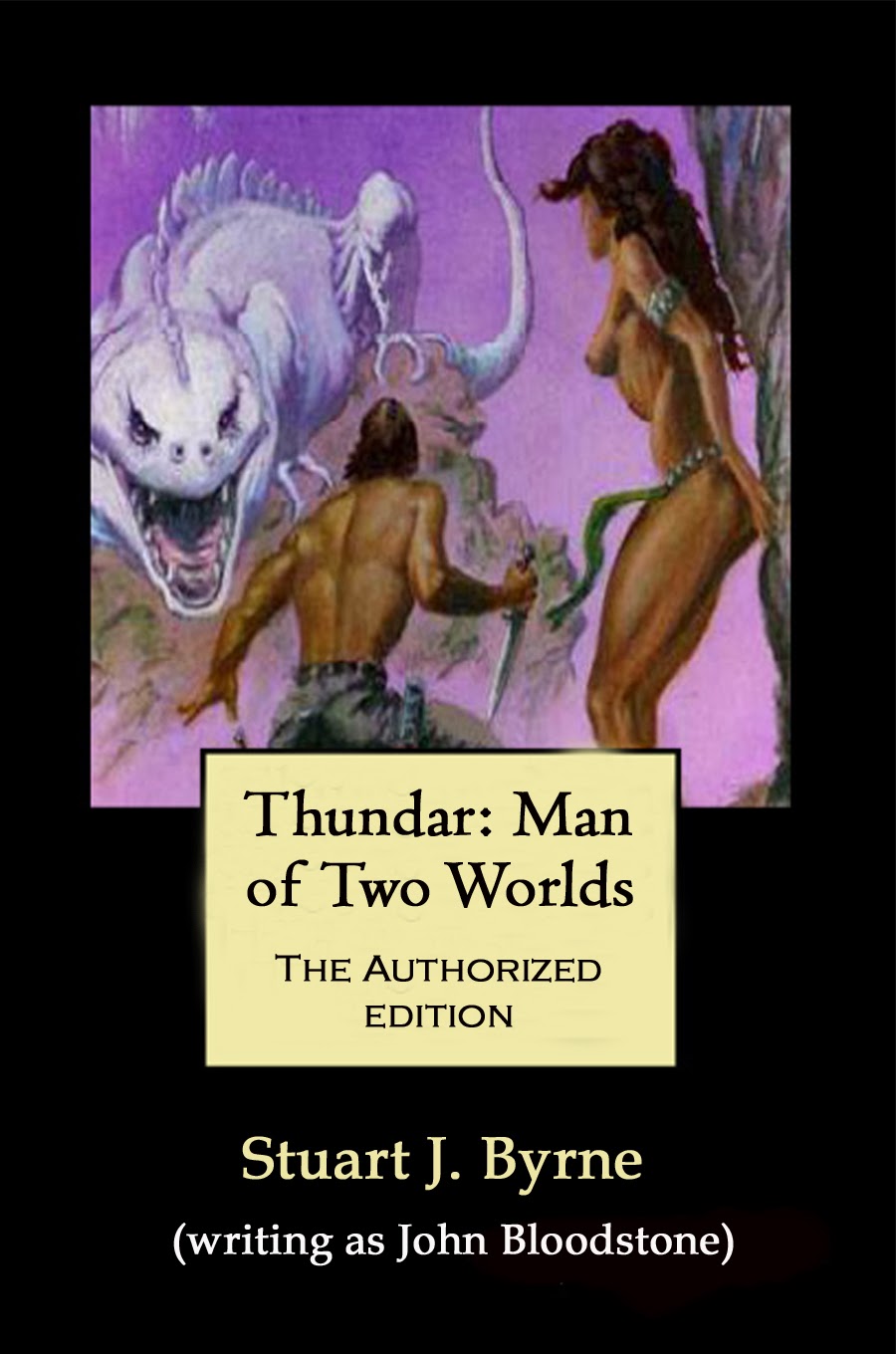
 [Note: the author of Tarzan on Mars, as the book was astutely titled, was to be revealed as one John Bloodstone. When one Burroughs' attorney was impressed with Bloodstone's style, he suggested Bloodstone write his own ERB-style fantasy adventures' using his own characters, the author responded by penning the novels Thundar - Man of Two Worlds and Last Days of Thornas, plus the Michael Flannigan trilogy, all in the ERB classical fantasy style. Only $2.99 each for Kindle at Amazon.]