This is part 2 of a four part recounting of former
Amazing Stories editor Raymond A. Palmer's 1955 attempt to persuade the heirs of Edgar Rice Burroughs to allow him to license writers to produce new Tarzan and John Carter novels. One of the greatest showmen since P. T. Barnum, Palmer realized that crossing the two series by having Burroughs' two most famous characters meet in a new novel would generate headlines, and millions in free publicity for such a book, around the world.
This was not the pure pipe dream it seemed, as Burroughs had written his last Mars, Venus and Pellucidar novels for Amazing Stories when Palmer was its editor-in-chief. If Burroughs had written for him, why would the estate turn him down?
No fool, Palmer figured having all Burroughs fandom at his back and advance orders of 20,000+ copies would help cinch the deal. So, the canny Palmer started his campaign, not with ERB Inc., but with fandom via the science fiction magazine he now published, Other Worlds. He flung down the gauntlet with the November 1955 issue, which featured a cover by long-time Burroughs' illustrator, the immortal J. Allen St. John, and the headline: Tarzan Never Dies!
Inside was a ten page, closely reasoned and highly emotionally charged, article of that title, which was nothing less than a clarion call to fandom to back his crusade. This is what Palmer wrote:
Here is
an article which represents a challenge to all those millions in whose mind
Tarzan
still lives. And along with Tarzan, all our other friends, such as John
Carter of Mars; La of Opar; Tars Tarkas, Jeddak of Thark; Manu the Monkey; The
Great White Apes; Numa, the Lion; the Holy Therns; the Waziri; the Firstborn…
and many more, none of whom will ever die within our memories where we cherish
their wonderful adventures, never before equaled, and unequalled since. But
Edgar Rice Burroughs, their creator, is dead. His typewriter is silent. And
down the musty corridors of the world’s bookstalls stalk the ghosts of
adventure, at bay at last, trapped in the past, never more to battle for their
lives against impossible odds, nevermore to rescue their mates from dangers unmentionable,
nevermore to thrill us, except in retrospect, with red-blooded adventure
exciting beyond all imagination. Aye! It is a prospect to make even the gods
weep!
I
knew John Carter personally. That’s how I knew how real he was. I met him much
later than Tarzan, for I grew up with Tarzan. There never was any question in
my youthful mind that Tarzan was real. Had anyone asked me, I could have
answered triumphantly with his real name, Lord Greystoke, of England, and none
could have swayed me from the conclusiveness of this proof! Today I might feel
a bit sheepish about it, but the knowledge that I was not alone comforts me,
nay, makes me proud. For here is vindication. Here is proof of the real talent
of the greatest of all writers, Edgar Rice Burroughs. He fooled me! Completely.
Along with hundreds of thousands of others. George Washington may have been a
myth, but Tarzan really lived!
When
I first met John Carter, he was equally vivid in my mind, and perhaps I loved
him more than I loved Tarzan, because the bent of my mind was toward more
fantastic imaginings, toward other worlds, lands beyond the stars. Yet, knowing
he was fiction bothered me not a whit. When he lost his Dejah Thoris, I wept.
When he found her, I cried with joy. When he carved his way to her side with
his mighty broadsword, I screamed with excitement. And when he clasped her once
more in his arms, I almost swooned with passion, such was my happiness. So,
imagine, if you can, my pleasure at meeting him!
Yes,
I met John Carter. Not only did I meet him, but I planned with him his next
adventures! And at my behest, novel after novel rolled from the typewriter of
Edgar Rice Burroughs, all of those last famous books that mark the end of a
great writer’s career. Yes, I treasure those last days. I was editor of Amazing
Stories and Fantastic Adventures then, and as editor, I persuaded Edgar Rice
Burroughs to write these new novels for me, novels that never have been written
otherwise. I persuaded him, some think, to obtain the famous man for my
magazines, to increase their circulations to the (then) world’s greatest in the
fiction field. But I’m going to tell you a secret now that I’ve never told
anyone before. The real reason I worked so hard to convince Edgar Rice
Burroughs to write for Amazing Stories, was because I was hungry for more John
Carter. I, personally, wanted to read more of those magnificent novels! It was
the most selfish action in the world, in one respect, and as it turned out, the
most generous – for millions the world over enjoyed wit me these new adventures
of those characters who can never die. The thought of that pleases me more than
any memory of my past activities. To link my name with that of John Carter, in
actuality! To be responsible for some of his adventures! What greater ambition
can a boy have! What more tremendous attainment!
Today,
when I pick up my tattered copy of The Gods of Mars, I am overwhelmed with
emotion. I handle the book as tenderly as though it were the most priceless of rare
editions. To me, technically, this book is the best of all Burroughs’
creations. It is his masterpiece. It is within its pages that Mars becomes more
real to me than my own planet! This book, and The Moon Maid, I consider the
epitome of story-telling, true literature, examples of the writing art which
can stand the assault of time, and which stand as targets for every writer who
has his soul in his writing, and who desires to attain perfection. How many
times have I re-read them both? You would smile and say: “He must know them by
heart!” That I do! Oft in the night, I walk through the Valley Dor, musing upon
the heroic deeds that once transpired here. Again, in my mid, I see Tars
Tarkas, the giant Thark, as he battles beside John Carter, against the great
white apes while the death call of the Holy Therns rings out from the high
cliffs all about. And sometimes, after I drop off to sleep, my subconscious
mind devises new fantasies so engrossing that awaking enrages me.
Today
I am still hungry for more John Carter. Oh what I wouldn’t give to pick up new
novels and follow new adventures of all those wonderful characters I love so
well, and who are more than characters, but real, living people. In my mind
they stand beside the memory pictures of other living people, as equal as flesh
and bold – and they will be ever so. In my mind’s eye, I can see Tars Tarkas’
great eye, twinkling upon me with ferocious humor, and a wave of affection
sweeps over me.
It
is not enough to say Tarzan can never die! That is small solace for the fact
that his is a
living death! Forever, like a puppet, he must now swing through
the trees only on the vines of the past. All he can do is re-enact what he has
already done. Not one more banth can John Carter slay, but only those already stiffened
in their dried blood! The pity of it!
For
Tarzan is not dead! Nor are hundreds of questions we can ask that remain
unanswered. One example: what about La of Opar? Is she never to attain any true
happiness? Is that incredibly lovely woman doomed forever to remain among the
troglodytes of Opar, with no prospect for a mate save a beastly half-human? You
could, in ten minutes, phrase five hundred such questions. What about the ninth
Barsoomian Ray; or the tenth? What about Kar Komak, that one lonely Phantom
Bowman who became flesh? What about the religion of Mars, now left without one?
Will the Holy Therns one day try to restore the ancient religion of Issus? The
Great White Apes; what about them? Several times we saw them trying to become
men – and almost succeeding. Will they ever succeed, and what will happen if
they do?
For
years these questions have plagued me. The realization that they could never be
answered caused an actual sense of sorrow, of loss. Sometimes I half-hoped when
I saw a new Tarzan movie announced – and returned from it so sadly
disillusioned that I swore never to go to another. No one, it seemed, could
take up where the great Edgar Rice Burroughs left off. John Coleman Burroughs,
his son, tried it. With all respect to a great man’s son, it just didn’t jell.
Many
times I visited with J. Allen St. John, the famous illustrator of the Tarzan
and Mars
stories, a personal friend of ours. There I saw several new pieces of
Tarzan art. A new painting of Tarzan, a thrilling, nostalgic thing. But always
it is the same – we talk of the glorious past. To St. John, Dejah Thoris IS the
most beautiful woman two worlds have ever known. He has painter her many times.
Her image is always in his mind as a mental model for any woman he paints. He
loves her as much as John Carter does!
Turning
to platitudes, we say that in that Land where we’ll once more meet Edgar Rice
Burroughs, perhaps he’ll continue the adventures of his characters for our
enjoyment. How could it be Heaven otherwise! And on this last mournful note we
sink back, reach for our tattered copy of The Gods of Mars, and retrace our
steps into the past, for that is all we have left. And like introverts, we
retreat into ourselves, and look out upon a world that has taken so much
anticipating from us with a snarl of futility.
Tarzan
can never die, but he might just as well! T'would save the poignant pangs of
longing that assail us always.
And
yet, the other day it happened. I could hardly believe my eyes, but when I
realized what I had in my hands, I questioned not, or hesitated, but plunged
into what has since become the prime adventure of my reading life – for what my
eyes beheld, in words, was a familiar character, La of Opar, for whom the High
Priest, patient no longer, had come to make her his mate. At last her most
feared hour was upon her – and in her heart she knew she would not live the
night through, for rather than mate with this horribly stunted, hairy beast,
she would die at her own hand.
One
hundred thousand words later I was in ecstasy, the happiest man alive – for all
my questions had been answered, and I knew at last what had happened to Kar
Komak, who was the true Issues, and how Mars got back its ancient religion! No
longer was The Gods of Mars the best of the Burroughs books – here at last was
a better! Here at last was the supreme novel, the book for which all the others
were only preparation, only plot-shadows casting before them the portent of the
giant to come! Here was the book that welded the whole series into one
complete, magnificent plot, cohesive in every unit, from the Apeman himself to
Jason Gridley.
And
on the heels of this came the most unkind barb of all – for to read this great
novel is forbidden! No man may read it. It cannot be published, for to do so is
plagiarism. And this is one plagiarism that nobody could get away with. Legal
action would be swift and relentless.
Is
there no way! we demanded. And the answer was as cold as ice: No, there is
nothing to be done.
If
a man writes a novel for his own enjoyment, he can write what he will. He can
use any character he pleases. It is legal. It is not plagiarism. But let him
sell it, or publish it, and he faces the law. If a man wishes to build himself
a patented machine, he can do so, for use in his own home. Even to the label.
None can stay him. But let him try to sell it, and the patent law is invoked
upon him.
There
is only one way: to get permission from the copyright owners or the patent
owners.
This
novel that I have read (I cannot say who wrote it); would you like to read it?
Is there a Tarzan or John Carter fan the world over who would not? Would you
like to read this, and many more? There is only one way it will ever come about
and that is to convince the copyright owners of a proposition I am about to
make in the following words. It is presented to you readers as a challenge. The
results will be up to you.
I
hereby propose that the Edgar Rice Burroughs interests nominate a successor to
Edgar Rice Burroughs to continue the adventures of all his famous characters. I
further propose that they nominate a man who has proved he can continue in the
high standard and tradition of Edgar Rice Burroughs, as based on 100,000 words
already written. I propose that Tarzan and all his friends be allowed to live
again, and walk once more through the pages of the books of the land, for the
enjoyment of the millions of fans everywhere.
Certainly
the Burroughs interests stand to profit immensely. All the author requires is a
fair remuneration for his work. He is willing to sacrifice all personal rights
in the stories he shall create, except those which come under the fair
remuneration already mentioned.
In
the interests of perpetuating these beloved characters, and making possible
their future adventures, which I am now more hungry than ever to read, I
propose to handle the task of convincing the Burroughs interests of their
proper course, and of the huge fortune such a decision can and will make them.
The way to accomplish that task is simple – that of public opinion. If enough
public interest can be demonstrated, the rest should be easy.
Therefore,
to begin with, I am asking every Burroughs fan who reads this to send me his
name and address with these simple words: “I’ll back you up on Tarzan!” When I
have enough names and addresses, I will contact each and every one of you, and
instruct you as to the next step. Can I get 100,000 names on my desk within the
next 60 days? If you’ll send me yours, it will be a start – and if you’ll go
out and contact every other Tarzan fan you know of, who might not read this
magazine, and get him to do the same thing, it won’t be any trick at all!
Naturally
this is going to cost me money, and I’m prepared to spend it. I must spend it!
It cannot be that this wonderful novel never become more than a pile of manuscript
pages written for the personal satisfaction of one Burroughs fan who so loved
his characters that he did a thing never heard of before – wrote his own novel,
for his own pleasure, knowing it could not profit him a nickel! He has the
world’s largest cross-file of information, concerning every book, every
incident, every character in Burroughsiana. He is, to my mind, the only man who
has both the ability, and the familiarity with the characters, necessary to
continue the Burroughs stories in a manner undetectable from that of the master
himself!
If
I fail, none of you will ever read what happened to La of Opar, and to Kar
Komak, and to Tarzan and John Carter as they fight back to back on Mars. Nor
will you ever know the identity of the man who has written it, for there is but
one manuscript, and it is his. And it will be a great pity.
If
any of you care to assist me in the cost, say by sending a dime, I will put it
into a “Dimes for Tarzan” fund, and use it to create the gigantic wave of
public opinion which is the only possible way to convince the proper person
that what I have proposed is the thing to do.
But
it is not really necessary, for I will do it alone if you do not wish to help.
My own prayers have been answered, and my joy has overwhelmed me. For me,
Tarzan is far from dead! Deeds unknown to millions of his fans, are already
familiar parts of my memory of him – and what great deeds they are! I shall
never forget that fantastic leap that Tarzan made that saved the armies of La,
and of Tars Tarkas, from certain death in the rising waters of the Gorge of
Tarnath. Nor shall I ever forget… but why speak of it? The mention can but whet
an appetite that may never be satisfied.
Send
me your name and address, and tell me you are willing to help. If it were
Tarzan, he would spring instantly to your aid. And all you have to lick is a
3-cent stamp!
Do
it now, and round up everybody else you can find. Write to: Ray Palmer,
Amherst, Wisconsin.
(Look for part three of this special presentation of the history behind Tarzan on Mars, which will detail the response of both the Burroughs' interests and fandom to Palmer's plea, as well as recounting the writing of Tarzan on Mars from the author's point-of-view.)
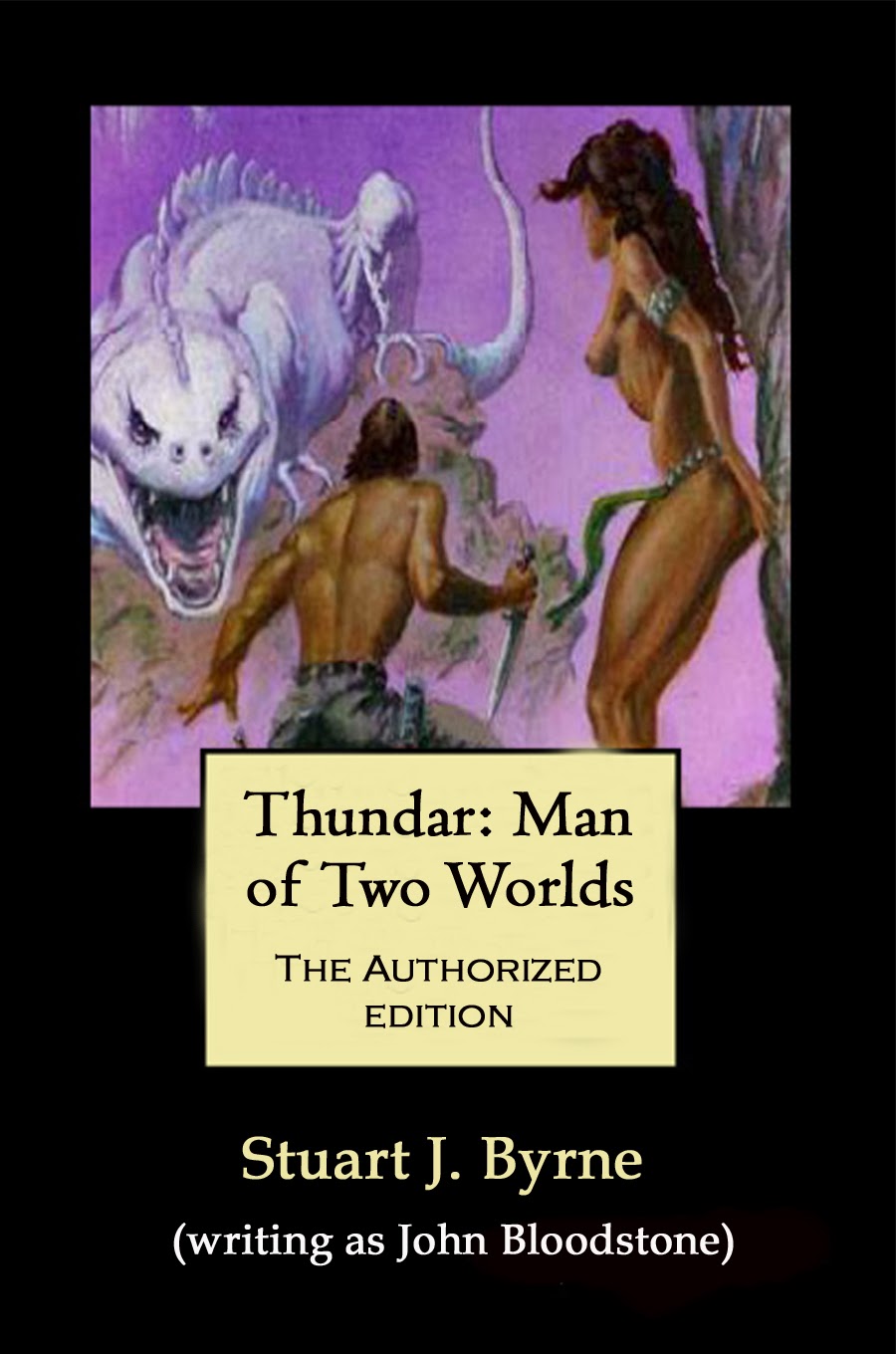
 [Note: the author of Tarzan on Mars, as the book was astutely titled, was to be revealed as one John Bloodstone. When one Burroughs' attorney was impressed with Bloodstone's style, he suggested Bloodstone write his own ERB-style fantasy adventures'
using his own characters, the author responded by penning the novels Thundar - Man of Two Worlds and Last Days of Thornas, plus the Michael Flannigan trilogy, all in the ERB classical fantasy style. Only $2.99 each for Kindle at Amazon.]


 It even encompassed
the Captain Future stories, knitting all his work into a disparate whole.
Various portions of this future were published in letters-to-the-editor and
story-behind-the-story columns, as well as in footnotes to some novels.
 (Hamilton ended the outline he provided Thrilling Wonder Stories here. But this only encompassed the early years of the settling of the solar system. We will feature an expanded version of this history that Hamilton wrote later, detailing the remaining years of the two thousand centuries his history of the future encompassed in a forthcoming blog.)